Showing posts with label OS Open Data Locator. Show all posts

Tuesday, 15 February 2011

Government Open Data License FAIL

I'd like to illustrate this post, but it's taken so long to work out whether I'm allowed to I haven't had time left.

I wanted to extend my analysis of various OSM datasets by correcting for population density. A simple and obvious way of doing this is using the Super Output Areas defined by the Office of National Statistics.

Firstly, the data are not available on-line. Last week I completed the rather horrible Word document form available at the ONS site. I was pleased to get the CD promptly in the post yesterday. So far so good, just 5 days delay compared with an online download.

Next, I thought I'd check through the T&Cs: I expected a non-commercial license or restrictions similar to those of Natural England and other bodies which allow you to use their data, but not to show it to anyone else. So here are the main terms:
There is no restriction on the use of the material except that:
• a click-use licence must be obtained for re-use and publication;
• an end-user licence issued under a click-use licence must contain these terms and
conditions;
• copyright and source must be acknowledged[4] on publication;
If I want to make an image using the boundaries and show it on this blog, I require a click-through license. In fact even if I printed out an image and tried to photocopy it in a public library I need a click-through license!

OK, how do I get a click-through license?

A link in the terms took me to the National Archives site, which mentions two kinds of license: an open government license, which has nice clear terms:
• copy, publish, distribute and transmit the Information;
• adapt the Information;
• exploit the Information commercially for example, by combining it with other Information, or by including it in your own product or application.

You must, where you do any of the above:

• acknowledge the source of the Information by including any attribution statement specified by the Information Provider(s) and, where possible, provide a link to this licence;
There is also something called the Parliamentary License which does have a link to a click-through license page, this time at OPSI (Office of Public Sector Information). This site does state:
1. Did you know?
We have completely changed the way you can use Crown copyright information. In fact you probably don't even need a Click-Use Licence anymore. This is because the information previously made available under the PSI Click-Use Licence is now offered under the Open Government Licence
Although I'm probably OK under an OGL, it's a bit difficult to be sure, so I thought I'd better register anyway. Finally there is a clear statement:

IMPORTANT CHANGES TO LICENSING
Crown copyright Information previously made available under the PSI Click-Use Licence is now offered under the Open Government Licence

Yeah!

But I've already waited 5 days for the data, and now I've spent a frustrating hour going from pillar to post between sundry websites belonging to different government departments all with slightly inconsistent messages.

If the ONS had published the data online they could have up-to-date license information, rather than old stuff pertaining to when the printed the CD, and I would have known exactly what I could and could not do with the data.

Enough moaning, time to use the data. Oh, there's another file of T&Cs, this time from the Ordnance Survey ...

Sunday, 6 February 2011

The Mysterious Case of Kenyon Road


ITO have recently released various enhancements to their OSM Analysis1 tool, and the race is on to get local authority areas above 95% completion.

Not a hope in Nottingham, were we're just shy of the 85% mark. Firstly, many of the missing roads are in un-surveyed areas, and, if possible, I don't want future surveys compromised by 'armchair mapping'. Secondly, the OS data often misses many addresses in modern areas of social housing, usually because they have a name, but no associated residential street. I've noted a few lately along Arnold Road, and also on Haydn Road. So even if we ostensibly are 'road-name complete' many addresses in the city would not be located on OSM.

However, I am very content to add names to areas which have been armchair mapped in the past. Doing so adds value to the existing data, without seriously compromising the need to survey. I do not add additional features missing from such data, unless I have seen them myself. Nor do I correct apparent spelling errors, except when I can check against the original source: these may reflect a real difference between what is on the ground and the OS data. Similarly I do not change geometries.

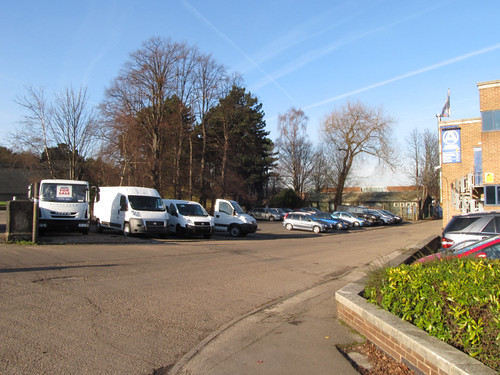
Using OSM Analysis, and using the not:name=* tagging convention has enabled some 150 roads to be cleared, with around 500 to do. BUT, there's one really close to my local survey patch, which I can't resolve: Kenyon Road (picture above). I know the small stretch of concrete well : as you can see from the photo it mainly provides hard-standing for lorries. Although it will show up as Kenyon Road in all sorts of maps &mdash OS MasterMap, GoogleMaps , BingMaps &mdash there is no evidence on the ground. I presume the road started out providing access to premises sited on an awkward bit of land sandwiched between the Nottingham Canal and the River Leen. Around 1975 the local Scout troop sold a small portion of land to the truck dealer to widen the road, so I don't believe it's a public road. The company's address is 522, Derby Road, so its not used for addresses. Furthermore, the name does not appear on out-of-copyright 25 inch to the mile maps from 1937-1940.

So ever since OS Locator came out I've had a dilemma: is this just a small error creeping in everywhere from erroneous OS data; is it a 'book' name, that is one never used except on official maps; or is it an obscure name known to a small number of locals. There is a glimmer of information in the latest issue of the Lenton Times, where the road is mentioned in an excerpt from the 1957 Kelly's directory. I plan to follow this up and ask the experts at the Lenton Local History Society. In the meantime it remains un-named.


View Larger Map

I mentioned this at WhereCampUK, and someone pointed out that this type of in-depth investigation of a single streetname is something that neither the Ordnance Survey nor commercial providers are every likely to do. It's one reason why OSM has the potential, as Chris Hill put it on IRC the other day,
"not to be the best free map, but the best map".

1. Registration required.