I remarked in my
OpenCageData interview that I see many similarities between biological recording and OpenStreetMap contributions. Indeed, I've had some interesting discussions about this with
Prof. Muki Hakaly at UCL. Muki's group now do extensive research across the gamut of activities which fall under the rubric of "citizen science", so I'm hopeful that they will elucidate which features are common across this spectrum.
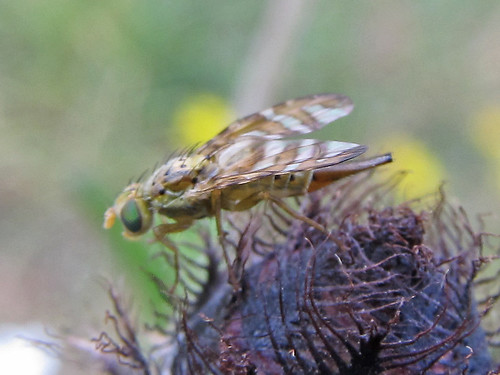 |
A female Chaetoraellia jaceae, a tephritid fly whose larvae feed on Knapweed.
Photo: (c) mausboam, Flickr. |
Basically, we know that there is a very long tail of smaller contributions to OpenStreetMap. Both
Harry Wood and
Frederick Ramm gave presentations on aspects of this at SotM-14 in Buenos Aires, and Richard Fairhurst also touched on this at SotM-US in 2013. Very recently
Marc Zoutendijk has used data collected by Pascal Neis to examine a cohort of new Dutch OpenStreetMap contributors from 2014 and 2015.
The usual hope expressed by people doing this type of analysis with OSM data is that by better understanding of these contributions we can improve the number of people who continue to contribute after the initial sign-up and first edit.
My perspective is slightly different, because it is coloured by knowledge of the much longer history of biological recording.


