Showing posts with label Retail. Show all posts

Tuesday, 24 July 2018

Can we identify 'completeness' of OpenStreetMap features from the data?

At the Milan SotM conference Stefan Keller from the Geometalab at HSR (Rapperswil) will talk about recent work of his group on identifying "Areas of Interest" (AoI) from OpenStreetMap data. Stefan has been kind enough to involve me in some discussions about this work as it has progressed, but in this post I am solely concerned with a separate issue arising from the use of points of interest in this work.

Growth of shops mapped on OSM for selected Local Authorities
(See Analysis section below for commentary)


Areas of Interest were introduced on Google Maps back in 2016. Loosely they correspond to shopping, entertainment and cultural areas with large clusters of relevant points of interest. No doubt Google not only used map features, but also other sources of data such as location of Android phones to calculate the footprints for Areas of Interest (shown in a pale orange or salmon colour on Google Maps).

There are issues with the Google implementation, some discussed in this CityLab article from 2016. My own examination of Google Maps confirms that shopping areas which are otherwise equivalent in range and type of shops are chosen as AoI in wealthy areas, but not in poorer areas dominated by social housing. I also found some places, notably the UBS IT centre in Altstetten, Zurich, which have erroneously been identified as AoI by Google. The work of Geometalab is therefore interesting not just in terms of whether OSM data can be used to calculate similar areas, but also to provide suitable data where biases based on socioeconomic status can, at least, be identified and corrected because data and code are open.

Zurich, centre and Aussersihl districts, showing Areas of Interest.
Work of Geometalab, derived from OpenStreetMap data.
The starting point for this type of work relies on areas where POI mapping density is high and reasonably complete (for instance, the areas of Switzerland which Stefan's group have looked at, and areas of the English East Midlands and Germany which I have looked at both recently, and in the past). Given that it is possible to calculate reasonable AoIs from OSM data where PoI density is high, the question arises "Can we identify which areas are 'reasonably' complete?". Normally, this type of work has involved comparing OSM data to some external reference data which are assumed for the purposes of comparison to be complete (for instance Peter Reed's work on UK retail). However, in many parts of the world, and for many topic domains there is no readily usable data for this purpose. So the ancillary clause for the question is ", and we do this with OSM data alone?"

This post is a first look at the problem for one class of POIs:  shops.


Wednesday, 9 September 2015

Shops in Coalville


I had not planned to do much mapping on the Bank Holiday Sunday: the day was set aside for a meeting of the British Plant Gall Society at Ryton Woods, Warwickshire.

Oak with Hazel coppice stools, Ryton Wood.
The ground layer changes here with bramble (in foreground) absent deeper into the wood.
Just to the left of the foreground hazel a bank & ditch can just be discerned. This is probably the remnants of a woodland compartment dating back to the Middle Ages.

The only thing I expected to map were paths in the wood, which surprisingly are almost all unmapped (hint to Mappa Mercia folks). This is one of the best areas of ancient woodland in the county and only a short distance from Coventry and Warwick. In fact, if anything, I would have expected to write about this wood which is mainly Oak with Hazel coppice.

Coalville, Hotel Street geograph-3151694-by-Ben-Brooksbank
Coalville : Hotel Street in 1988.
The Railway Hotel is now a day nursery, and the buildings on the left beyond have recently been demolished.
The Railway was one of a cluster of pubs adjacent to the level crossing and station: the others continue as pubs.
Source Ben Brookshank, Geograph via Wikimedia Commons

Tuesday, 19 May 2015

Retail Outlets on OpenStreetMap: Cartograms, and Patchwork Quilts

I enjoyed the process of creating a cartogram from OpenStreetMap data a couple of years back, even if it was somewhat tedious. However two things stopped me from taking it further: the QGIS plugin I was using does not work with later editions, and I really wanted something a little more refined.

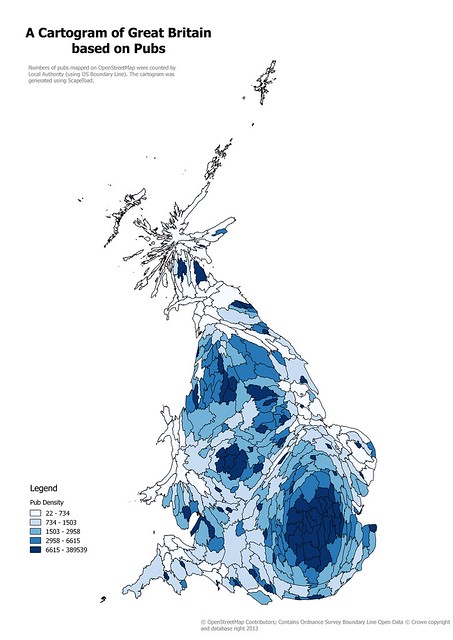
Pub Cartogram
Cartogram of Local Authority areas in Great Britain based on numbers of pubs on OpenStreetMap
Created using ScapeToad, this is a simple, and naive, cartogram.

Friday, 28 June 2013

The Shopping News: mapping retail outlets in Nottingham

Nottingham Open Data 6


ng_retail__detail20130613
Nottingham City Centre retail areas with mapped retail units
(shops, banks, pubs, restaurants, cafes, fast food outlets etc.;
the large areas are shop=mall (an unsatisfactory tag)).

ng_retail_20130613
Retail landuse and retail outlets in the city of Nottingham
(a buffer is used to accentuate smaller retail outlets)

This morning I achieved one of my targets for using Nottingham Open Data. This was 90% reconciliation of the Licensed Premises dataset (this compares with around 40% when I first blogged about it).

Tabulation of reconciliation of Nottingham Open Data Licensed Premises File vs OSM
(loaded as an image because turning my Excel stuff into an HTML table is a PITA).
It seems like a good time to take stock (pun intended) of my retail mapping within the city of Nottingham.

ncc_miss_lic_pcs_20130628
Licensed premises from Nottingham Open Data not reconciled to OpenStreetMap
(plotted as number of premises at postcode centroid) cf. with original map.
I started doing this when my mother asked me to take her to church and I realised that I could do a short productive mapping session whilst she was at the service. For the following 2-3 Sundays I mopped up as much as I could in the area close to her Church. Then at the end of April I got serious and instead of doing my shopping locally I drove to other groups of shops when I had an errand. In this way I've visited the majority of local shopping areas (with two major gaps: Mansfield and Carlton Roads).

Most mapping sessions have been just over an hour in length, mainly involve photo mapping and seem to generate a huge amount of data. With a small number of exceptions in the City Centre I haven't done repeat surveys. Apart from trying to take lots of photos I have not tried to map everything I came across, which has been my usual approach in the past. I started doing this on my first outing, and took 30 minutes before I mapped my first shop, and had only 10 minutes for other shops, so I was going to take forever doing it my old way. So I stopped worrying about grabbing everything and just tried to get shops, but did collect other information if it was convenient and readily accessible.

I distinguish between these two styles of mapping, by analogy with farming, as intensive and extensive. In one we put all our efforts into maximising yield (of crop, or OSM data) from a small number of hectares; in the other we are happy if the yield is good enough.

What I've done.

  • Added postcodes to as many as 5,000 objects. (It's a little difficult to check as I have touched objects which already had postcodes).
  • Added around 1,200 different postcodes, about 20% of the city. (Again some may have already been present.)
  • Added around 5,800 housenumbers. These are not just retail premises, but houses close to shopping areas, and when I've walked along streets I've tried to add house numbers at intersecting streets.
  • Added over 2,500 buildings.
  • Taken 7,000 photos. Of which around 6000 are now available on OpenStreetView.
  • Recorded about 13 hours of mapping audio.
  • Loaded around 200 kilometers of GPX tracks.
What I've still to do.
  • Finish adding POIs for shops (particularly in the City Centre).
  • Indoor mapping in the two main Shopping Centres (Malls) in the middle of the city.
  • Finish adding building outlines in the retail landuse polygons (I'm tending to do smaller ones first)

Things I've learnt (and why)

  • Map all shops in a group together. If a single shop changes use or closes and the row of shops has been mapped it is often impossible to reconcile which shop has been affected. It's far better to be systematic for a small area than mapping patchily. Exceptions can be made for very recognisable buildings or POIs. (This also helps check that POIs are in the correct location, see below).
  • Open Data Addresses are great. The Open Data is not accurately geo-located (only to postcode), but it does contain the address. This meant that as long as I could locate the business on Bing aerials I did not need to collect detailed address data. This made surveying less arduous. 
  • Good high-quality building outlines help. A single building outline covering a whole block is useless. A lot of Nottingham City Centre had building polygons mapped not from aerial photography but from OSGB StreetView. Firstly the building outlines were not very accurate. Secondly, it is very time consuming to divide and correct such amorphous polygons.
  • Good photos and; decent aerial photos are critical. I have taken a huge number of photos (all available on OpenStreetView) to assist this mapping. I try and get photos of the roof line as I can correlate chimneys, dormer windows and other roof-line features between the aerial photos and my street level ones. It is amazingly easy to displace a POI a few tens of metres even with all this information.
  • Android Apps aren't much use in a City Centre. I made some use of KeyPadMapper3, but found the data often needed to be tweaked because my android phone GPS location wasn't too good. In the City Centre the canyon effect even with a Garmin is too much. A further reason not to use the phone is that I was already using a camera, two GPS (one in the backpack) and a digital voice recorder, juggling these and the phone was too much. The phone did come into it's own when the batteries ran out on the dictaphone. In the end I used the voice recorder for most addresses I collected. I didn't try Vespucci.
  • History of POIs is enormously helpful. Most of the errors in the Open Data are failures to update historical data (POIs closing, changing ownership, re-branding, or moving elsewhere). In many cases Nottingham mappers have kept the historical information when updating POIs, and this means that it's mush easier to reconcile OSM with the Local Open Data.
  • It's really difficult to tell if some POIs are still open. See the associated post on Vanishing Pubs.
  • Night-time surveying is the only way to check the status of some Bars, Nightclubs and Fast Food outlets. I'm too old to be a night owl, so someone else needs to do this.
  • POIs change fast. (Well I already knew this) My re-surveying of Market Street, Mansfield Road and Upper Parliament Street/Forman Street, which were all done 2 years ago by Paul Williams enables the rate of change to be quantified.
  • A 5% error rate in local government open data seems a reasonable assumption. This is not too different from rates found with NaPTAN and Ordnance Suryey Open Data Locator. It does mean that it's far better to use this data as the basis for survey (as we have done with Locator) rather than import (as was done with NaPTAN).
  • Local Government Open Data needs significant interpretation. It is collected for discrete purposes, and there is no integration across data sets. I presume licences are granted for a number of years. Therefore there are no checks as to whether the licence is still in use, or even has ever been used, until renewal time.
  • Extensive surveying is more fun, and less exhausting, than intensive surveying. By an intensive survey I mean one intended to collect all types of mapping data in a discrete area. Extensive surveying involves covering a larger area perhaps with some specific targets, but most information is collected as a side product rather than with deliberation.
  • It was a good mapping project. A targeted set of POIs makes for a reasonable mapping project over a shortish term.
  • More Systematic Coverage. Extensive surveying means more systematic coverage of the city: even if not in great detail.

What to do next

The next steps are fairly obvious. 

  • Repeat for Food Hygiene Data. I have an additional data source from the City Council which covers POIs which serve food (anything from fast food outlets to schools and hospitals). This is about twice the size of the Licensed Premises file (2400+ cf. 1200 POIs) and at the moment I have only reconciled 70% of the data. In the main this means checking more day nurseries, care homes and similar establishments.  

  • ncc_miss_fhrs_20130628
    Premises from Nottingham Open Data Food Hygiene file
    not reconciled with OpenStreetMap (cf. with image above).


  • Change Detection. Build a mechanism for automatically detecting change in the source data. So far I have just used a snapshot of the data, but it would be very useful to find changes in the source data files and use them to drive surveys.

  • Create additional tools for Food Hygiene data. The Food Hygiene data is actually available for many parts of the UK and is Open Data. There are at least 350,000 POIs available. It is usually safe to assume that it is accurate at the postcode level, but in the nature of retail outlets several are usual present in each postcode. It would be nice to be able to create layers for mapping (e.g., in JOSM, Potlatch etc) which spread the FHRS POIs out around their postcode location preferably ordered by housenumber in the right direction. It would also be good to be able to load subsets of this data as POIs or similar into Garmin or Android devices.

  • Developing sensible categories for retail. In some of the images in this blog post I have used an ad hoc categorisation of available amenity=* and shop=* values. It would be useful to develop a more considered version of these categories.

Conclusion

The most important thing is that this project would never have started without the availability of Local Government Data. Although I could have tried to find and map retail outlets I would have missed many isolated ones, and would have had no idea how many more there were to find.

With retail data mapped systematically it becomes possible to evaluate exactly how we use tags and if there are any obvious improvements. Remember that Nottingham is the 8th largest retail centre in the United Kingdom and is therefore a reasonable exemplar for all but the largest retail centres in Europe and North America.

A consequence of trying to be systematic is that I have visited areas of the city which have had very little on-the-ground mapping. I have been able to collect other POIs, addresses, correct road alignments etc.

Lastly, this is a very productive and rewarding means of mapping. If you have any local open data on shops I recommend a bit of Retail Therapy.

Wednesday, 5 June 2013

Vanishing Pubs

As I've surveyed shops in the past few weeks I've been completely amazed to see how many pubs have closed in the past 2-3 years. I wrote about mapping former pubs a couple of years ago.

Vernon Arms
The one that provided the initial idea for this post : Vernon Arms, now a Sainsbury's Local
This is a photographic selection of some I have encountered in Nottingham over the past few weeks, with a sprinkling of ones which closed long ago, but which I used to frequent. I've tried to be reasonably eclectic in my choice of pubs and their current uses, unfortunately I didn't realise that a Police Station was a former pub.


Wednesday, 24 April 2013

Segmentation of Retail Landuse: why do Germans only map shops?

de_retail_karlsruhe
Retail Landuse in Karlsruhe on OSM (scale 1:50k) :
both explicitly mapped and derived landuse polygons are shown, see below for methods.
The availability of lots of open data on various kinds of retail outlets has led to me doing a lot of maps of shops, restaurants, fast-food outlets and bars lately. I'm following in the steps of Paul the Archivist who mapped the Mansfield Road area close to pub meetings we had in 2011. I've got a nice workflow : I map my target area for an hour on Sunday morning, usually trying to get all retail establishments in a quite small area. I also try and collect as many house numbers as I can. I discovered my new mapping protocol, because my mother asked me to drive her to church a few weeks ago and I found it very productive. It also means I've been actively surveying in a neglected inner-city area.